Don't skip the rebound
 By Cyro
And that most people aren't ready at first to dig that deep. So yoga lures them into that self-reflective space by making the promise that if they keep coming back, they'll eventually be able to touch their toes.
I'm not gonna lie; this is precisely how yoga got me hooked in the first place. And when I think about it I can't help but looking at my old self with a knowing smile. When I started, I was more interested in the acrobatics of the body than the ones of the mind. But with time, I understood that everything I learned on the mat, I could use off the mat too.
I don't always teach dynamic vinyasas. In fact, most of my permanent classes nowadays are Yin classes. Which is pretty ironic considering that I used to not enjoy that practice very much. If you don't know Yin, I wrote an article about this style a few years ago that explains in more details all the benefits and challenges of this practice. But in a nutshell, I see it as another angle - another way to get into the mind-body connection - using stillness instead of movement. Quiet the distractions, shush the noise, remain present despite the discomfort - either physical, emotional or mental - see what comes up and hold ourselves accountable without judgment. Arguably, I find the Yin practice way more challenging than any movement based practice.
The first principle of Yin is to 'find your edge'. Which means being able to identify the fine line between discomfort and pain. Breathing through discomfort is practicing resilience. Eventually our threshold will expend: we'll make more space. But pain isn't a place we wish to go visit. So the first step in Yin is to tune in and assess what it is we're working with. I can tell you that despite my best efforts and countless cues, there are always a few students who want to push through what their body clearly doesn't seem to be ready for. That's the ego talking. I don't blame them though, I've been there myself. On and mostly off the mat.

A few weeks ago I bought a brand new toothpaste. It was advertised as 'new formula' ever more efficient to 'brighten your teeth', and it was 50% off. A whitening bargain. When I first used it, it felt as if I was literally brushing my teeth with bleach. Or what I believe bleach would taste like - not that I ever tried that (don't). But because I 'invested' in this product, and the promise of it, I pushed through and kept brushing my teeth with it despite its horrible taste. Since then it's almost become a running joke at home. "I'm off brushing my teeth. Wish me luck", and what used to be part of a pleasant ritual - getting ready for bed - transformed into a reluctant step. I'm now 2/3rd of the tube down and as I was brushing my teeth the other night, I told my husband "I've forgotten how good toothpaste tastes like. I'm wondering how I'll react next time I use something nice, or just regular mint flavoured. It's gonna feel weird." My husband looked at me and said "Funny how we get used to uncomfortable things, right?".
He wasn't talking about toothpaste.
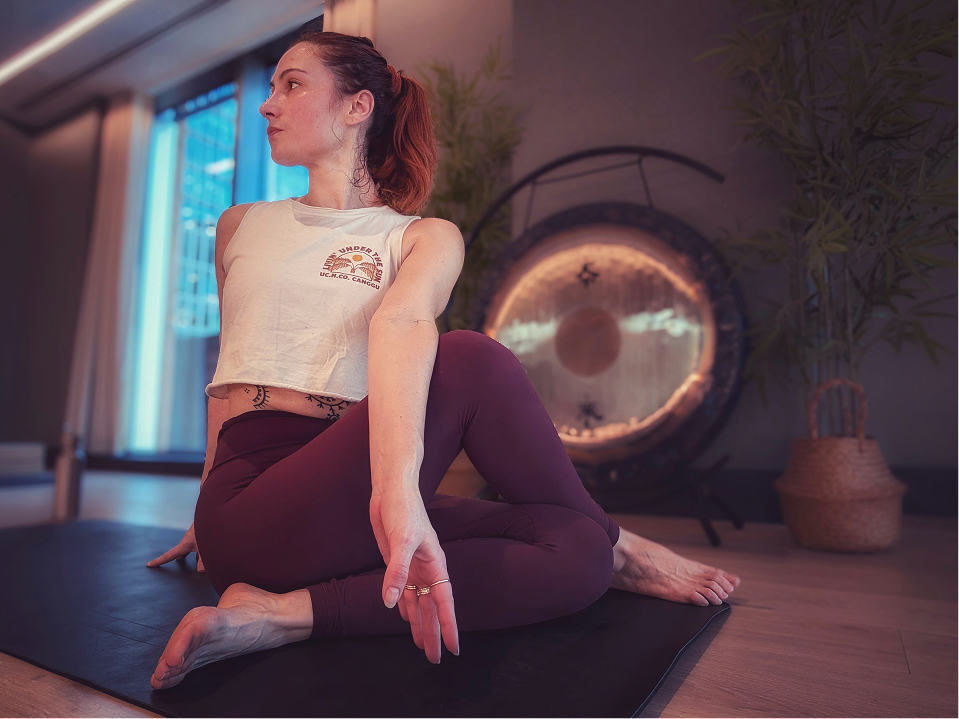
In Yin, we hold each pose for 3 to 5min in average. Each pose works with an area of compression, and an area of stress (we don't talk about stretch for ligaments/tendons/fascias...), which is what creates the discomfort. When we release from a pose, we go into what's called a rebound. A rebound is pretty much the absence of compression and stress. It's 'getting back to neutral'. So we remember how comfort feels like.
I've always applied this principle to my Yin classes - I understand the need for a physical release - but I never really thought about the 'off the mat' practice of rebound.
And that made me think: am I really capable of identifying stress if I don't have moments of peace?
My agenda is always very much packed. I work, I teach yoga, I practice, I play music, I spend time with my friends... I'm always out and about. Most of the time, it doesn't feel like stress. But when everything slows down, I then realise that I rarely have time to do, literally, nothing. Just rest. Rebound.
In the past few weeks I've had quite a lot of time for that. And guess what? My body immediately reacted - I slept like a baby - my mood improved, and my energy came back. And I realised that I had forgotten what comfort feels like.
Rest is part of the practice. Rebound is necessary to properly integrate the work. Like learning by contrast. And when we skip the rebound, we forget how comfort feels like. When I teach Yin, I always invite my students to notice what emotions or thoughts come up whilst they're holding the pose. Because everything we feel and think will affect our practice. It will make it more challenging or more manageable. But we all need to get out of the pose at some point. I guess I forgot to do that off the mat.
The body reacts first but the mind intellectualises and overrides.
I'm not saying that we should never push ourselves. I'm saying it's important to pause and reflect, and ask ourself why we keep pushing.
- Does it serves us?
- Does it honour our needs at this specific moment in time?
- Do we need to push or do we need to let go?
That's the practice. That tricky balance between too much and not enough. That's the yoga.
Comments
Leave a comment.Fields marked with a * are compulsory. Your email won't be published.
Thanks, your comment has been posted successfully. It will be visible on the website once it's approved.
Google says you're a bot...